Scope Measurement
Hints
Poor
Man’s TDR
A
quick and inexpensive way to check for defects in cables (LAN cables,
BNC cables, etc), is to use a pulse generator and a scope as a TDR
system.
Output
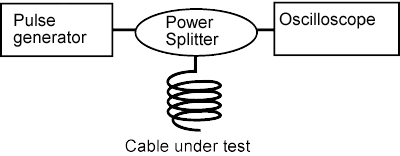
a < 1 ns pulse from the pulse generator through a power splitter,
with one end into the scope (50 ohm input) and the other into the
cable under test. See set up in Figure 1.
Figure
1
Perform
a TDR measurement on a known good cable of the same type as the
suspect cable. This will give you an idea of the appropriate response.
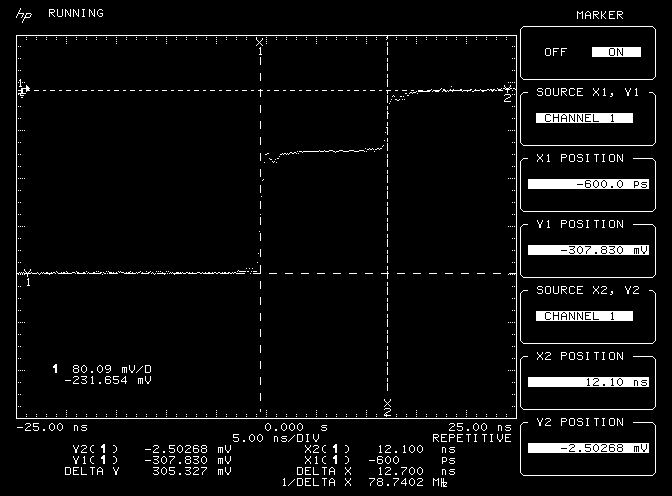
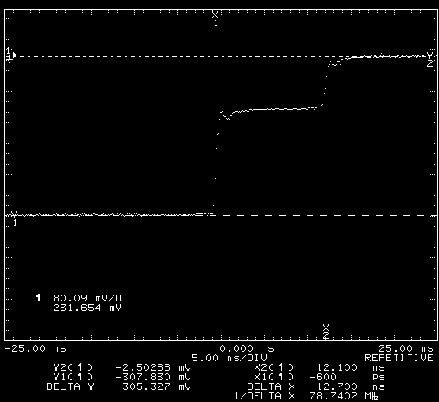
Figure 2 shows the TDR response of a BNC cable. The first step you
see is the pulse output from the generator. The second step corresponds
to the unterminated end of the BNC cable. For this BNC cable the
step travels out to the end of the 4.13-foot cable and back in 12.7
ns. The velocity constant is v = distance/((delta t)/2) or 4.13/((12.7)/2).
In this case v is approximately 0.68 ft/ns.
Figure
2
Now
you can do a TDR measurement of the suspected cable and locate defects
using the formula distance = ((delta t)/2) * v. An open circuit
will show as a step up, and a short will show as a step down.
HP
54520- and HP 54540-series oscilloscopes have an AC cal signal with
< 1 ns risetime. This makes it even simpler to do a poor manís TDR.
Simply substitute this cal signal for the pulse from the pulse generator.
|